
Not just on the price of the asset. On the exchange itself.
You’re trusting that the platform won’t freeze withdrawals. That it won’t get hacked. That it won’t do what FTX did. Your capital is in their hands, and you have no say in that.
Self-custodial perpetual futures change that entirely. You trade with the same leverage, the same execution, the same markets. But your assets never leave your wallet.
What Are Perpetual Futures?
Perpetual futures are derivative contracts that let you take leveraged long or short positions on a crypto asset, with no expiry date. Unlike traditional futures, you can hold them as long as you want (subject to funding rates).
They’re one of the highest-volume instruments in crypto. Traders use them to:
- Amplify upside on a position without selling their spot holdings
- Hedge against downside without exiting a position
- Express a directional view on any asset, in either direction
The problem has always been custody. Until recently, perpetual futures were almost exclusively available on centralised exchanges, meaning you had to deposit your capital onto a platform you don’t control.
The Custody Problem with CEX Perps
When you deposit on Binance, Bybit, or OKX to trade perps, you’re not trading with your money. You’re trading with an IOU.
The exchange holds your assets. You hold a balance on their ledger. If the exchange has a problem (a hack, a regulatory action, an insolvency event) your capital is caught in the middle.
This isn’t hypothetical. It has happened repeatedly:
- FTX: $8 billion in customer funds gone overnight
- Celsius: withdrawals frozen, users unable to access their own capital
- Multiple exchanges have halted withdrawals during periods of market stress
The industry learned a hard lesson: not your keys, not your coins applies to trading capital just as much as it applies to holdings.
What Self-Custodial Perpetual Futures Actually Mean
Self-custodial perps let you trade with leverage directly from your own wallet. Your assets stay under your control, secured by your private keys, at every stage of the trade lifecycle.
No deposit to an exchange. No withdrawal delays. No counterparty risk from the platform itself.
The trade executes on-chain or through a non-custodial protocol. You open and close positions, manage margin, and realise gains. All without ever giving up ownership of your assets.
This is what Tria is built for.
How Tria Does It Differently
Most self-custodial perps solutions still have friction. You’re navigating a DEX interface, managing gas, bridging assets to the right chain, and handling execution manually across fragmented liquidity.
Tria removes that friction entirely.
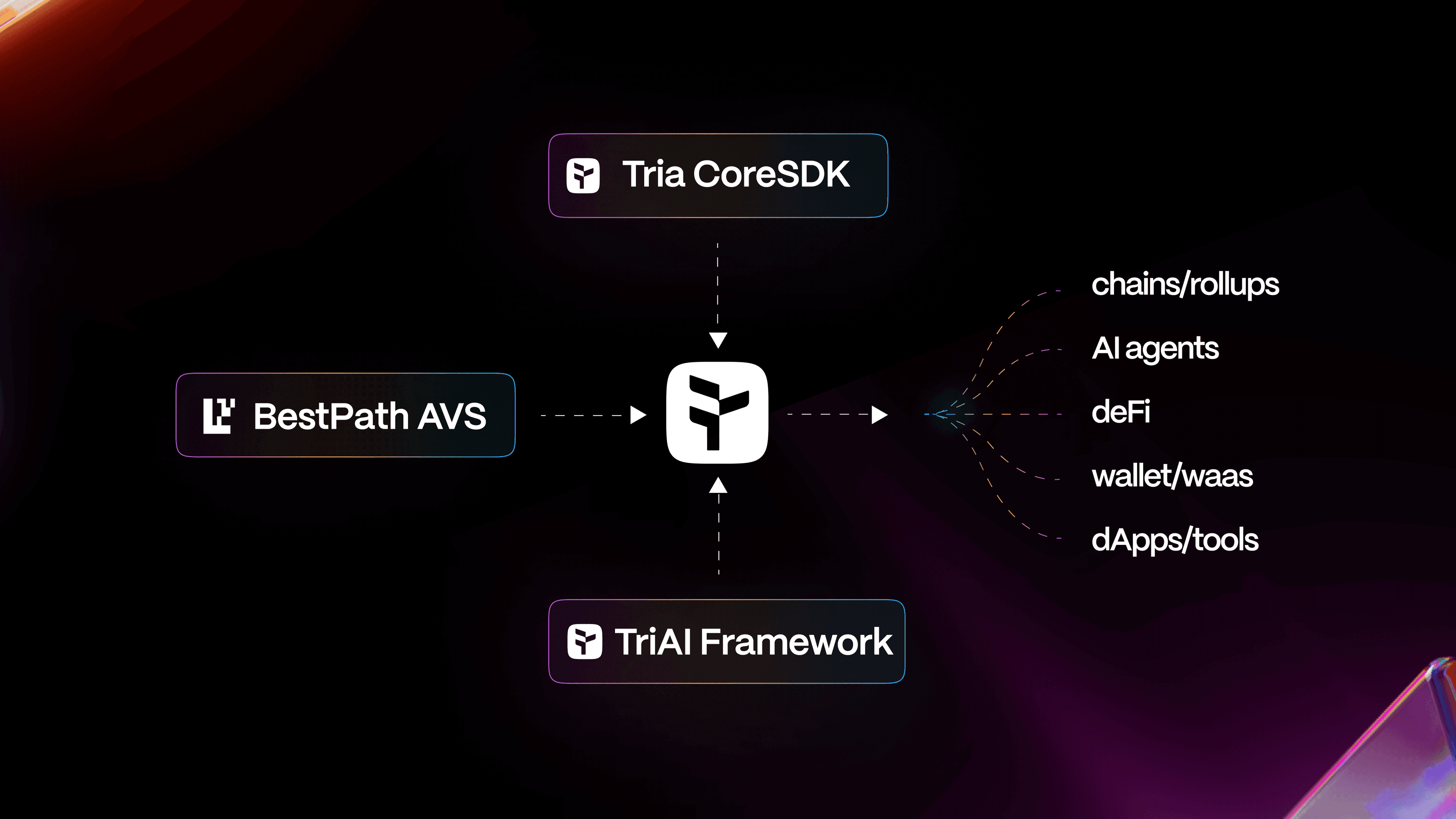
BestPath, Tria’s routing engine, finds the optimal execution path across 200+ chains and 70+ protocols automatically. No bridging. No gas management. No missed trades because you were on the wrong chain.
You trade perpetual futures from your self-custodial balance. Your capital earns yield in the vault between trades. When you spend with your Tria Visa card, the cashback redeploys as tradeable capital. Every action feeds the next.
That’s the difference between a self-custodial trading app and a self-custodial neofinance ecosystem.
The Flywheel That CEXs Can’t Build
Centralised exchanges can never offer this. Their model depends on holding your capital. The moment they give you true self-custody, they lose their leverage over you.
Tria’s model works in the opposite direction. The more your capital moves, the more value you get back.
Trade $10K in volume and unlock higher card cashback tiers. Earn yield in the vault and get fee discounts on trading. Spend with your card and generate cashback that feeds back into your trading balance.
On a CEX, your capital sits on their platform earning them revenue. On Tria, your capital moves through an ecosystem that rewards you for every trade, every spend, every yield position.
Why This Matters Right Now
Self-custodial perpetual futures are having a moment. Blockchain.com just launched perps inside their non-custodial wallet this week. MetaMask added perps via Hyperliquid. The category is moving fast.
But most of these solutions are single-product: a self-custodial perps interface bolted onto a wallet.
Tria is the only platform where self-custodial perps sit inside a complete neofinance ecosystem, connected to spending, yield, cross-chain swaps, and a compounding reward layer.
Your keys stay yours. And your capital keeps working.
Getting Started with Tria Perps
- Open the Tria app and connect your self-custodial wallet
- Fund your balance. No deposit to a third-party exchange.
- Navigate to Perps and select your market
- Set your leverage, direction, and size
- BestPath routes your execution automatically
Your assets stay in your wallet throughout. When you close the position, the capital returns directly to your self-custodial balance, ready to earn, spend, or trade again.
Tria is a self-custodial neofinance app. Trade perpetual futures and spot across 200+ chains, earn up to 15% APY, and spend with your Visa card in 150+ countries — every action compounds the next.